
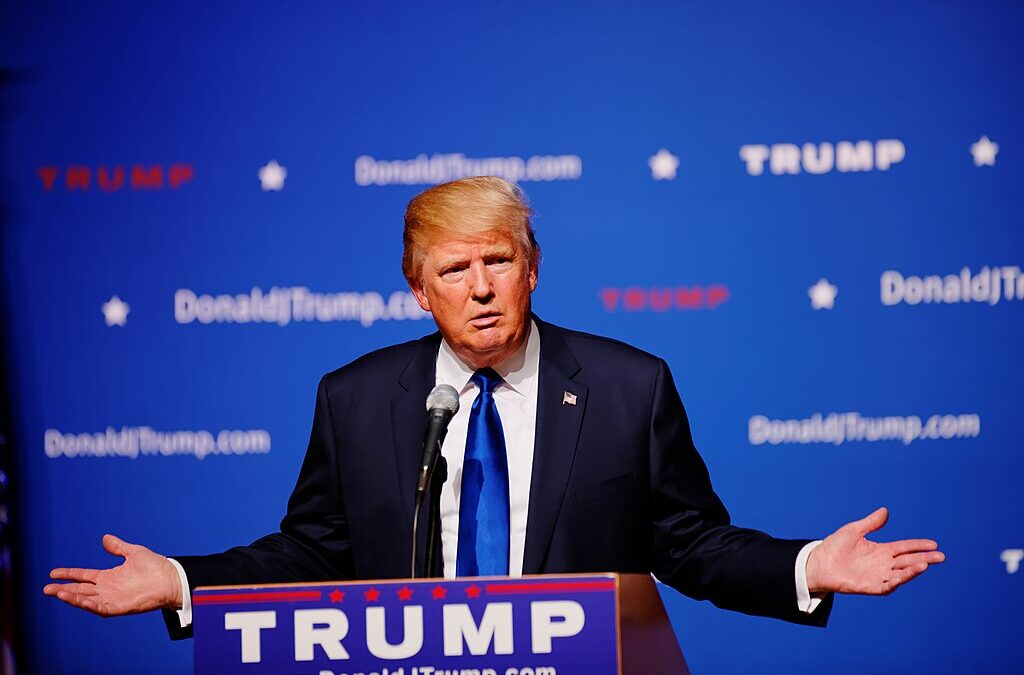

Donald Trump just said something out loud that the foreign policy establishment never expected to hear from an American president.
While Iran’s drones keep targeting tankers and diplomats shuffle between capitals with nothing to show for it, Trump stepped to the microphone in New York and made a statement that sent shockwaves through the region.
And now Iran’s own deputy foreign minister is firing back — which tells you everything you need to know about how hard that statement landed.
Trump Claims What the Blockade Already Controls
Speaking to supporters in New York, Trump said: “After we finish defeating Iran, which is being very badly defeated, pretty soon I’ll be declaring the Hormuz Strait a territory of the United States.”
He followed that by saying, “Essentially, that’s what it is. We have the blockade. No ships get through unless we want them to.”
Trump added, “The blockade is unstoppable.”
That’s not the kind of language you hear from a president who is losing. The crowd at the Nassau County Police Academy roared. And the crowd had a point — because the blockade numbers back him up.
The US currently maintains a naval blockade of the critical waterway, through which as much as 20% of the world’s oil supply flows. As of recently, US forces had “redirected 59 commercial vessels, disabled three and boarded two to ensure full compliance with the blockade,” according to CENTCOM.
Vessel transits fell to a one-week low of eight on a recent day, down from a five-day average of around 13 earlier in the week and roughly 94% below the daily average of 130 ships that transited the strait before the war began.
Iran’s response was predictable. Iran’s deputy foreign minister Kazem Gharibabadi fired back on social media, insisting “the Strait of Hormuz has been Iranian, is Iranian, and will remain Iranian; this strait will only be closed and opened under Iran’s command.” That’s the kind of statement a regime makes when it’s cornered and running out of options.
Bessent Loads the Next Round of Economic Pressure
The territorial declaration wasn’t even the biggest news of the day. Treasury Secretary Scott Bessent went on Newsmax and previewed what comes next — and it sounds like Tehran hasn’t seen anything yet.
“It will be a combination of economic isolation like the world has never seen before, and the continued blockade in the Strait of Hormuz that will keep anything from going in or out of the Iranian ports,” Bessent said in an interview with Newsmax, without elaborating further.
Bessent characterized the forthcoming actions as unprecedented in their scope and said President Trump has directed Treasury to intensify a pressure campaign that has already targeted Iranian financial institutions, assets, cryptocurrency accounts and government revenue.
The US has already imposed a naval blockade that has cost Tehran roughly $4.8 billion in oil revenue. Whatever comes next week is on top of that.
This is the America First approach to economic warfare — not endless boots on the ground, not nation-building, not another decade of entanglement in somebody else’s regional grudge. Squeeze the regime financially, hold the waterway, and let the mullahs calculate whether their nuclear ambitions are worth the economic strangulation. That’s a different playbook than the one that produced Iraq and Libya, and it’s worth noting that the people who gave America those disasters have been the loudest voices against Trump’s approach from day one.
Hegseth Promises the Navy Isn’t Going Anywhere
Defense Secretary Pete Hegseth made clear the US military can keep a blockade on Iranian ports for as long as needed, saying: “Indefinitely, the United States Navy can maintain a blockade like that because we’ll rotate ships in and out, as we have, and we’ll continue to.”
Hegseth also stated that President Trump has all the options to ensure Iran never has a nuclear weapon. “The president has all the options at his disposal and will ensure, as we have from the beginning, that a maniacal regime like Iran never has a nuclear weapon,” Hegseth said.
Reports have circulated about strain on sailors aboard the USS Abraham Lincoln, which has been deployed in the region for an extended stretch. Hegseth pushed back hard. He called the accounts “completely misrepresented,” saying, “We make sure every ship, every crew, every captain has everything we can provide them at every single moment. Some deployments are longer than others, and I have more respect and gratitude for those sailors than anybody. What they do in those high seas, in those austere conditions, with less port calls — it’s incredible.”
Reports indicate that the USS George Washington was headed to replace the USS Abraham Lincoln, which had been deployed for more than 250 days in the Middle East — well past the deployment end originally expected in May.
Iran Keeps Targeting Tankers While Talking About Rights
While the regime lectures the world about sovereignty over the strait, its forces keep attacking ships belonging to America’s Gulf partners.
The United Arab Emirates condemned Iran for attacking two ships linked to the UAE’s national oil company in the Strait of Hormuz. The Abu Dhabi National Oil Company confirmed that “two of its vessels were attacked while transiting” the waterway, adding that the situation was “brought under control.”
The UAE’s Foreign Ministry called it exactly what it is: “Targeting commercial shipping and using the Strait of Hormuz as a tool of economic coercion or blackmail represents acts of piracy by Iran’s Revolutionary Guard Corps, and constitutes a direct threat to the stability of the region, its peoples, and global energy security.”
ADNOC reported that 15 of its vessels had been attacked in the Strait of Hormuz since the start of the conflict, including three in a single recent week.
This is the regime that critics of Trump’s approach want to negotiate with on its own terms. The same people who argued against the blockade, against the pressure campaign, against any show of American strength — they’re still out there insisting that the problem is Trump being too aggressive. The Iraq-era foreign policy crowd never runs out of reasons why America should back down.
What Vance Said That Nobody in Washington Wants to Acknowledge
Vice President JD Vance, who has been the administration’s clearest voice for putting American interests first throughout this conflict, laid out the strategic logic in plain terms.
Vance told Fox News: “I know that oil is down today and it’s way down from the highs in the early days of the conflict. That’s goal number one — keep oil and gas cheap for Americans all over our country. And then obviously goal number two is ensure that Iran never gets a nuclear weapon.”
That ordering matters. Keeping energy affordable for working Americans is the concrete, daily measure of whether this strategy is succeeding. The nuclear question is existential, but it’s also long-range. Vance is the one in the room who keeps asking what the average American family is paying at the pump — and that’s not a small thing. The neoconservative crowd never put that question first. They put their preferred regional outcomes first and handed the bill to American workers.
Vance also said Trump was “at the height of his authority with a lot of tools — diplomatic, military and economic.” That’s a deliberate signal. The administration isn’t locked into one lane. The blockade, the coming sanctions wave, the territorial declaration — these are coordinated moves, not improvisation.
The Bigger Picture: A Deal Was Close Once Before
It’s worth remembering how close a resolution actually came. The US and Iran signed a 14-point memorandum of understanding on June 17 after two months of stalled talks. The interim agreement formalized the ceasefire, ended the US naval blockade, reopened the Strait of Hormuz, and dangled a bevy of economic incentives in front of Iran, including a broad waiver on oil sanctions.
Iran walked away from it. The regime chose continued confrontation over the economic relief that was sitting right in front of them. That’s not on Trump. That’s on a theocratic government that values its grip on power more than the welfare of its own people.
Iranian Speaker of Parliament Mohammad Baqer Qalibaf reportedly declared that “management of the Strait will never return to the way it was before the war.” That’s a regime telling the world it prefers permanent economic isolation to any deal that doesn’t hand it control of a global shipping lane. The Trump administration’s answer to that posture is the blockade, the coming sanctions, and — apparently — a territorial declaration that makes clear the US Navy isn’t leaving.
The people who want to frame all of this as recklessness should explain what the alternative looks like. Letting Iran operate a toll booth on 20% of the world’s oil supply? Pretending that a regime that shoots drones at allied tankers is a good-faith negotiating partner? Those aren’t serious positions. They’re the same arguments that have failed American foreign policy for decades, dressed up in new language.
Trump’s approach is hard-headed. It costs something in the short term. But it’s built on a simple premise: American power, applied consistently, produces better outcomes than endless deference to a regime that respects nothing except strength. The next round of sanctions will test that premise. So will whatever comes next at the Strait of Hormuz.
Sources: Fox News Digital, The Washington Times, Newsmax (via Bloomberg, Reuters), Just the News, CNBC, NBC News, UAE Ministry of Foreign Affairs, ADNOC, CENTCOM, Congressional Research Service, Britannica, ABC News
Stay connected