
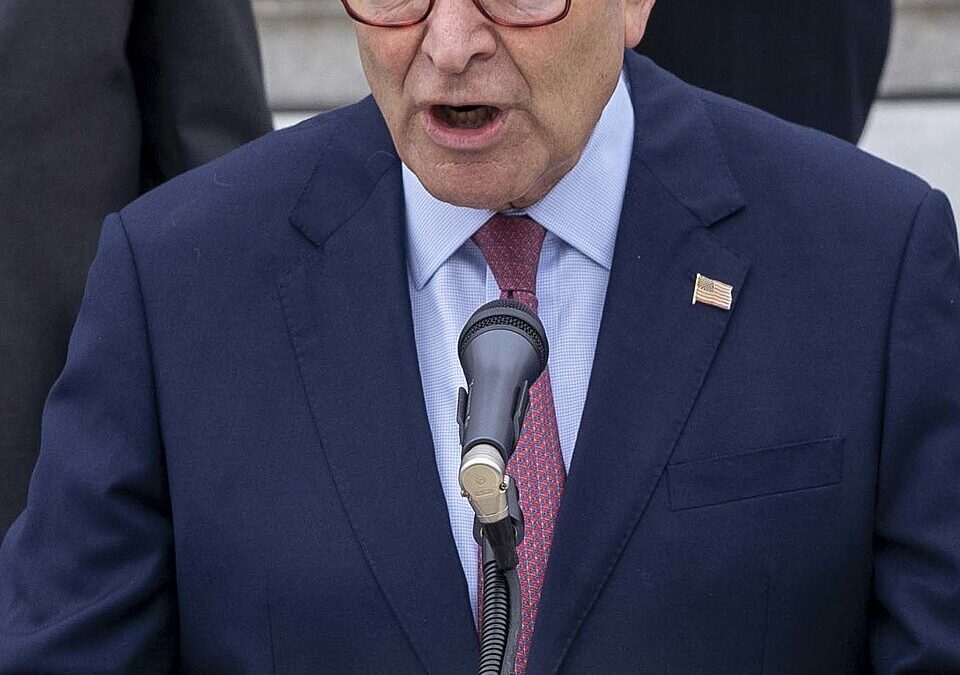

Chuck Schumer tried to bury Abdul El-Sayed during the Michigan primary.
El-Sayed won anyway — and now Schumer needs him.
So the Senate Minority Leader’s super PAC just wrote a check that tells you everything about how Democrats really operate.
Schumer’s Machine Drops Another $10 Million on El-Sayed
Senate Majority PAC, the main Democrat Senate super PAC aligned with Senate Minority Leader Chuck Schumer (D-N.Y.), recently poured an additional $10 million into the Michigan Senate race to boost progressive Democrat Abdul El-Sayed, bringing the group’s total spending in Michigan to $30 million.
That number is worth letting land for a moment.
El-Sayed built his entire political identity around getting money out of politics. He railed against dark money, outside PACs, and the party machinery during the primary — the same primary where Schumer’s wing of the party spent heavily trying to elect Rep. Haley Stevens (D-Mich.) instead. El-Sayed beat Stevens anyway, and now the same apparatus he spent months attacking is pumping tens of millions of dollars into his campaign.
And El-Sayed, asked whether he needs Schumer’s PAC investing in the race, said: “We’re having really productive conversations about what it takes to win.”
That’s a long way from his primary debate line: “If you need a $60 million crutch, you probably can’t be elected on your own terms.”
Mike Rogers’ communications director Alyssa Brouillet noticed the contradiction. “Are you going to return the money, Abdul? Or do the rules not apply to you?” she said.
A Meeting Full of Friendly Faces and Awkward Silences
El-Sayed made the rounds at the Democratic Senatorial Campaign Committee headquarters, where senators from across the ideological spectrum dropped by for what were described as friendly, forward-looking conversations. Lawmakers posed for pictures. People said nice things in the hallway.
Sen. Kirsten Gillibrand (D-N.Y.), the DSCC chair, delivered the official party line: “He’s a great candidate. He’s going to win, and we are all united.”
Not everyone was so effusive. Sen. Cory Booker (D-N.J.) declined to answer questions about how the meeting went. Sen. Sheldon Whitehouse (D-R.I.) called it “peachy” and “just a private conversation.” That’s not exactly a ringing endorsement.
El-Sayed himself kept things carefully vague ahead of his private sit-down with Schumer. Asked whether he would support Schumer for Democratic leader next year, El-Sayed declined to answer. He said: “I’m looking forward to a productive meeting because we need to win in the state of Michigan.”
And Schumer, asked by Fox News Digital whether he and El-Sayed had moved past their differences, said: “Look, we have to win Michigan, and we had a great and friendly meeting.”
Neither man answered the actual question. Two politicians in a room, both needing something, neither willing to commit to the other. That’s Washington, DC in a sentence.
What the Texas Contrast Reveals About the Democrat Machine
The contrast with how Republicans handle their own primary upsets is instructive — and damning for the GOP establishment.
Ken Paxton defeated incumbent US Senator John Cornyn (R-TX) in the Texas Republican primary. Cornyn, who championed Joe Biden’s gun control legislation and backed amnesty for illegal aliens, has declined to raise money for Paxton. Senate Majority Leader John Thune and the National Republican Senatorial Committee have withheld the kind of television spending normally deployed to defend a seat, a posture widely seen as institutional payback for President Trump’s decision to endorse Paxton.
The GOP establishment would apparently rather watch a Democrat win the seat than see a strong MAGA senator take it.
Democrats operate differently. After El-Sayed beat Schumer’s hand-picked candidate in a bruising, expensive primary, the party closed ranks. Within weeks, the same Senate Majority PAC that had worked against El-Sayed’s political orbit started writing checks. Schumer took a meeting. The DSCC chair called El-Sayed a great candidate. The machinery, whatever its internal reservations, got moving.
That’s the difference. And Republicans eyeing the Texas race should sit with that for a while.
What El-Sayed Actually Wants to Do in Washington
El-Sayed has been explicit about his policy agenda. He campaigns on Medicare for All, the government-run, single-payer healthcare scheme that would eliminate private insurance, ration care, and hand the federal government direct control over how Americans receive medical treatment. The real-world record of government-run healthcare systems — the wait times, the shortages, the denial of care — doesn’t seem to give him pause.
He has also described Israel’s actions in Gaza as a “genocide.” His closeness to Hasan Piker, a far-left Twitch streamer who reportedly said “America deserved 9/11,” has generated sustained pressure from both parties for El-Sayed to cut ties. El-Sayed said he was “united” with Senate Democrats on issues like healthcare access.
And he is running in a state that President Trump carried in 2024 — the only open Democrat-held Senate seat in a Trump state on the map this cycle. Republicans see that as a genuine opportunity and have spent accordingly. The Senate Leadership Fund has committed a total of $51 million in Michigan to elect former Rep. Mike Rogers (R-Mich.).
El-Sayed said: “All pathways to a Senate majority run through Michigan.”
He’s right about that. Which is why Schumer’s super PAC keeps writing checks to a candidate who won’t even tell reporters whether he’ll vote for Schumer as leader.
The Bigger Play Here
Dig one level deeper and this story stops being just about Michigan. Democrats who retake the Senate would put Schumer — or whoever succeeds him — back in position to rewrite the rules of the upper chamber. A Democrat majority is the prerequisite for the party’s structural ambitions: packing the Supreme Court with additional justices, granting amnesty to illegal aliens in a move designed to permanently alter the electorate, and adding new Democrat-leaning states to lock Republicans out of a Senate majority for a generation. These are not incidental policy preferences. They are the mechanics of permanent political control, dressed up in the language of reform.
El-Sayed also supports Medicare for All, which would hand the federal government total control over healthcare delivery for every American. Democrats who control the Senate majority could move pieces like that with far less resistance than they face today.
So Schumer writes the check. El-Sayed cashes it. And the “money out of politics” candidate heads into the fall with $30 million in super PAC backing from the very party boss he spent months running against.
The establishment always finds a way to make peace when the stakes are high enough. The question is whether Michigan voters remember who El-Sayed said he was before Schumer decided he was worth $30 million.
Sources: Axios, “Scoop: Schumer’s super PAC doubles down in Michigan,” September 16, 2026; Fox News Digital, “Abdul El-Sayed huddles with Senate Democrats ahead of Michigan race,” September 2026; The Hill, “Senate Democrats start to warm to Michigan’s Abdul El-Sayed,” September 2026; CBS News, “Senate Democrats meet with Abdul El-Sayed, rallying around Michigan nominee,” September 2026; OpenSecrets, “Michigan’s Democratic Senate primary is a super PAC battleground,” July 2026.
Stay connected