
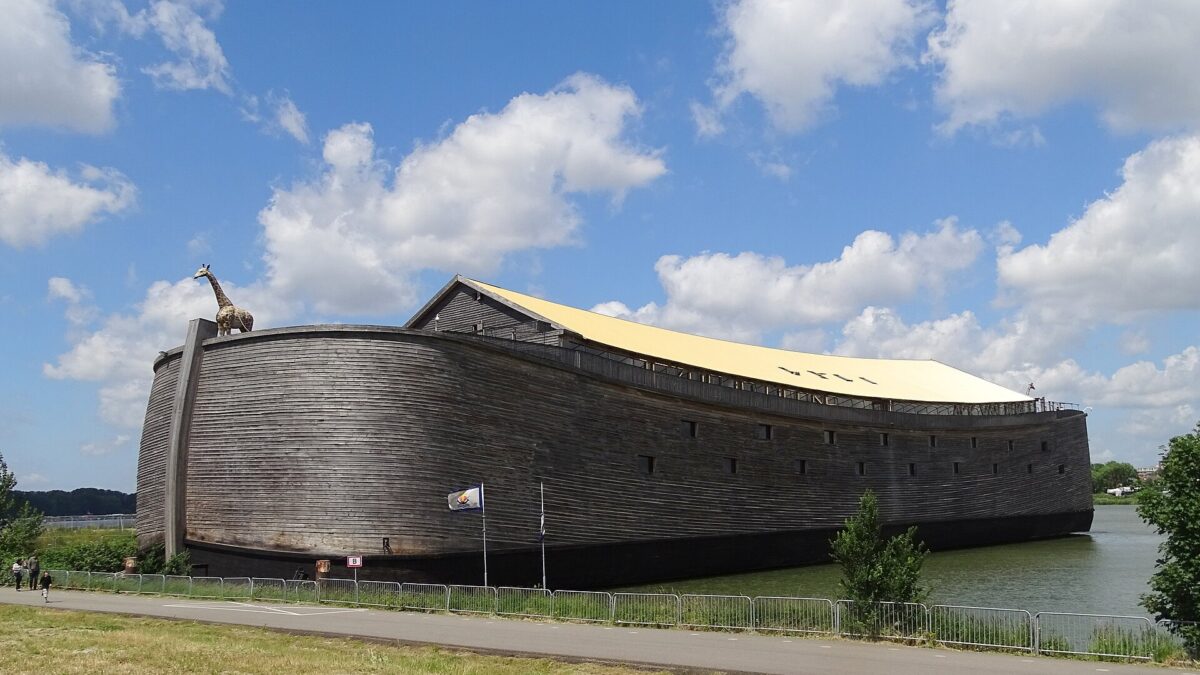

A boat-shaped mound has sat quietly in the mountains of eastern Turkey for generations.
Skeptics call it dirt. Believers call it destiny.
Now a team of researchers says fresh underground scans turned up something nobody expected to find buried in the mud.
Radar, Drills and the Search for Three Decks
An international team of researchers examining the Durupinar Formation near Mount Ararat now says it has “100 percent confirmed” that the mound is not a natural geological feature but a man-made object, according to the tigerdroppings summary of the Daily Mail report.
Recent radar surveys reportedly revealed structural layers, straight lines, right-angle intersections and large cavity-like spaces at multiple depths. And the team did not stop at surface scans.
Researchers claim scans show potential chambers, corridors and tunnels along with a thick underground layer dividing into three parts, a feature they compared to God’s command in Genesis for Noah to build the Ark with three decks. That detail alone has energized believers who have waited decades for this site to produce something concrete.
Andrew Jones, the founder of Noah’s Ark Scans, has led the effort. Jones is an American researcher who has spent nearly three decades investigating the Durupinar site in eastern Turkey, with his interest beginning in 1997 and extensive fieldwork starting in 2013.
Physical core drilling backed up what the radar suggested. Jones said the team was performing an extensive, permitted deep core drilling survey inside and outside the site, recovering samples, and at one point they were forced to stop drilling because they struck a layer so hard that the drill bit broke.
Jones told the Daily Mail that the drilling and radar work undercut the leading skeptical theory about the mound. He said the survey work “destroys the theory the site is a solid limestone block shaped into a boat by glaciers and weathering.”
He did not hide where he personally stands on the question. “I firmly believe the Durupinar Formation represents the buried remains of Noah’s Ark,” he added.
Lauren Witzke, who serves as marketing and fundraising director for Noah’s Ark Scans, described the site’s condition in blunt terms. Witzke said the upper section is deteriorating, noting “the top, and most exposed, tier is decaying.” She added that beneath the surface, the bottom two layers appear to still be intact, and the team believes it has hit a floor of petrified wood.
But nobody has actually proven that yet. Researchers have not confirmed the material is wood or dated any sample to 4,300 years, and Jones said that figure is a proposed biblical flood date, not a scientific age, since organic material from the cores must be isolated and radiocarbon-dated first.
The pottery angle adds another layer to the story. Pottery found outside the formation ranges from the Chalcolithic through the Iron Age, showing long human presence on the mountainside. Witzke floated a theory tying the artifacts directly to the biblical account. “It’s quite possible this pottery was used to store food and supplies on the Ark, and was used as Noah’s family exited the Ark and set up camp,” she said.
Jones, to his credit, did not let that claim get ahead of the evidence. He noted pottery alone cannot prove the mound is the Ark or that the people who left it were connected to the vessel.
The formation’s backstory reads like something out of a movie. The formation lies about 18 miles south of Mount Ararat, and local accounts say rain and earthquakes revealed its outline in 1948 to a Kurdish shepherd. Turkish Army Captain Ilhan Durupinar spotted the ship-like shape in aerial photos in 1959.
And the dimensions keep coming up in every account of this site for a reason. Scripture describes an Ark roughly 515 feet long, 86 feet wide and 52 feet tall. The Durupinar mound has long been cited as an uncanny match.
Geologists Still Aren’t Convinced
Not everybody buys it. Early excavators reported only soil and rock and judged the mound natural, and most geologists still do.
But that has not stopped the Noah’s Ark Scans team from pushing forward with new tools. The team plans to conduct further testing, including more advanced geophysical surveys and potential core drilling. Some accounts describe plans to lower an underground exploration drone, nicknamed GOPHER, into the voids the radar has already mapped.
Fossilization is another sticking point for skeptics. Scientists note that the fossilization of wood into stone requires millions of years, not the mere 5,000 years since the purported flood. That objection has followed this site since the 1980s, and it has not gone away just because the equipment got better.
History offers a caution here too. Ark hunters have been burned before. A 1993 CBS special once aired dramatic testimony from a man who claimed he had personally recovered a piece of the Ark, only for the whole thing to unravel as a hoax involving modern pine soaked in soy sauce.
That embarrassment still hangs over every new Ark claim that surfaces, fairly or not. And it is part of why Jones has been careful to frame this round of findings as promising rather than final.
What Does This Mean for the Search Going Forward?
This is not the first time the Durupinar site has generated headlines, and it will not be the last. But the shift from satellite photos and dowsing-style radar work in the 1980s to permitted core drilling and multi-university soil analysis represents a genuine change in how seriously researchers are treating this location.
For millions of Americans who take the book of Genesis at its word, a mound in Turkey that keeps producing right angles, layered decks and organic-rich soil is not a curiosity. It is a data point in a much older argument between faith and the academic establishment over whether the Bible describes literal history or ancient myth.
That argument has never been settled by a press release, and it will not be settled by this one either. Radiocarbon dating of the drilled material, if it ever gets done and gets published, would move this conversation a lot further than another round of radar imagery.
Until then, the Durupinar Formation sits exactly where it has sat for thousands of years, whether it holds the remains of Noah’s Ark or nothing more than a very stubborn pile of ancient mud.
Sources: Daily Mail, Israel Hayom, TigerDroppings, endtimeheadlines.org, NewsNation, Noah’s Ark Scans, michaeltsnyder.substack.com, NBC News.
Stay connected