
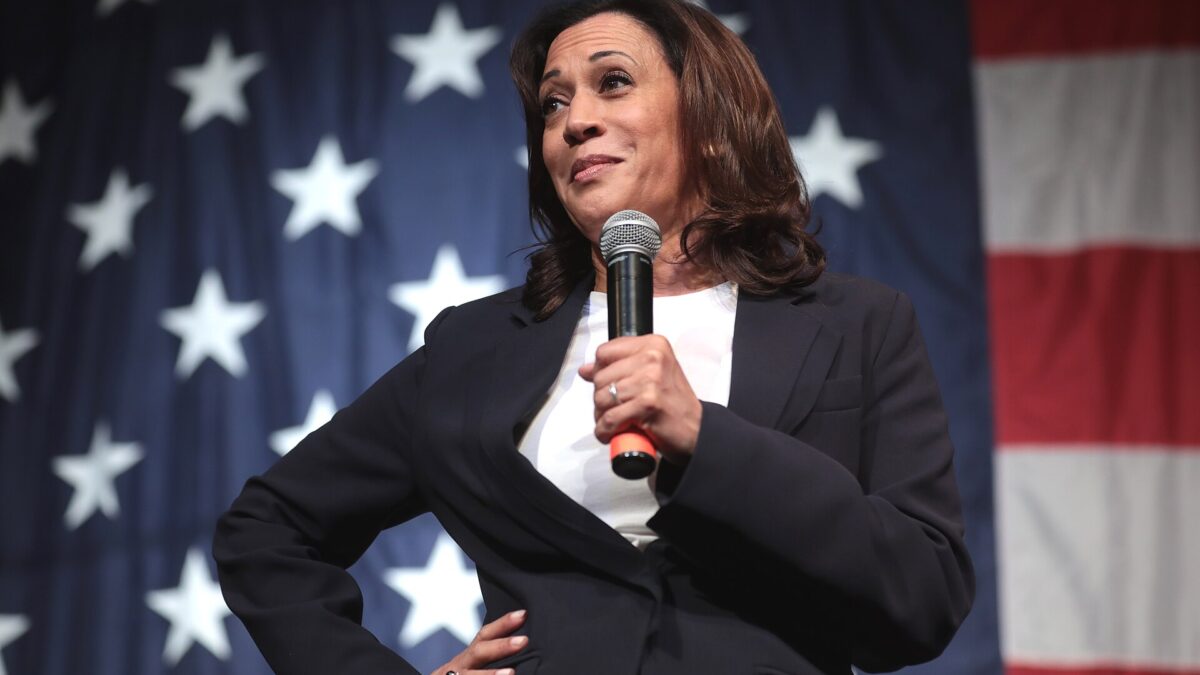

She is back on the campaign trail. Sort of.
Kamala Harris hit the podcast circuit again, and it did not go the way her handlers probably hoped.
And what she said about “power” in a single minute is already drawing reactions nobody expected.
The Clip That Has Everyone Talking
Former Vice President Kamala Harris grabbed on to the word “power” and didn’t let go for a hot minute while discussing the affordability issue and midterm elections with podcaster Big Boy, a.k.a., Kurt Alexander.
The appearance came on the latest episode of Off Air With Big Boy, and it followed a pattern anyone who watched the 2024 campaign will recognize instantly.
Harris touched on real concerns real people have. The cost of groceries. The price of gas. The grind of commuting long distances just to afford a paycheck that barely covers it all. Harris told the show she “was just in Jackson, Mississippi, with a mother of four whose weekly budget for the four of them was $150.”
Those are legitimate struggles. Nobody disputes the cost of living has hammered American families. Alexander noted that the average person cannot even afford to live where they work, spending long stretches in their car just to get to the job that pays for gas that is already too expensive.
But then Harris pivoted. And that’s where things went sideways.
“I believe in the power of the people,” Harris began, adding: “And that includes believing that part of our hope comes from our ability to fight for what we know is right and then to see the progress and and the potential for the progress, and let that give us hope. Right? I believe very strongly if you feel powerless, you are powerless. If you feel powerful, you are, you are powerful and we are powerful. But knowing that is what makes it happen. And so if we’re feeling hopeless, we are less likely to feel powerful. And I believe you should never let anybody take your power from you. No circumstance, no individual.”
Eight mentions of “power” or some variation of it in roughly sixty seconds. Count them. Power. Powerless. Powerful. Powerful. Powerful. Powerful. Powerful. Power. It is a rhetorical loop that circles back on itself without ever arriving anywhere.
Same Script, Different Podcast
For anyone who followed the 2024 race, this is not new territory. This is the same Kamala Harris who told an audience during the campaign trail that you have to “see the moment in time in which we exist in our present” and contextualize it “as it relates not only to the past but the future.” That clip went viral for exactly the same reason this one is: the words are all real words, arranged in grammatically functional sentences, that ultimately say nothing.
The pattern is consistent enough that even her own allies have called it out. Democrat strategist David Axelrod said publicly during the 2024 campaign that when Harris doesn’t want to answer a question, her habit is to go to what he described as “word salad city.”
She is not going to word salad city occasionally. She has a timeshare there.
And here she is again, on a podcast with a real audience, in front of working-class voters who genuinely need someone to speak clearly about costs, enforcement, and economic pressure, reaching instead for a motivational poster that would get flagged as AI-generated filler if submitted in a college course.
The ICE-related incidents also came up during the conversation. The conversation touched on recent incidents involving ICE, including the shooting and killing of two men in July. These are serious subjects that deserve serious engagement. What they got instead was a segue into a riff about inner power and hope as verbs.
To be fair, the affordability concerns Harris raised deserve genuine attention. A mother in Jackson, Mississippi stretching $150 across a week for four people is not a political abstraction. That is a real American trying to survive a real situation. The question is whether looping the word “powerful” eight times in sixty seconds does anything to help her.
The answer is no. And the voters Harris is supposedly trying to motivate for the 2026 midterms are smart enough to sense that.
What This Reveals About Where Democrats Actually Are
Harris is positioning herself as a voice for the 2026 midterms, stumping on affordability and immigration enforcement while building toward what many observers read as groundwork for another national run in 2028.
But the “power” clip reveals something that should concern Democrats far more than a bad soundbite. It reveals a candidate who, when asked to inspire and mobilize voters, returns to circular language that substitutes emotional cadence for actual argument. The problem with the message “you are powerful if you feel powerful” is that it places the burden for change entirely on the listener’s emotional state rather than on any concrete policy commitment from the speaker.
That is not inspiration. That is a way of filling airtime while avoiding accountability for anything specific.
And the substance problem runs deeper than rhetoric. Harris spent four years as Vice President during a period when inflation hit its highest point in forty years. Gas prices regularly crossed five dollars in major metro areas. Working families did not feel powerful. They felt squeezed. And the administration she served in offered few durable answers to any of it.
Now she tours podcast studios telling those same Americans to feel powerful. There is something slightly jarring about that sequence of events.
The midterms she is rallying voters toward represent a genuine moment of political consequence. Republicans defending House and Senate majorities have a record of their own to answer for, and voters in both parties are watching costs, enforcement, and institutional credibility with real intensity. Democrats will need a message that goes beyond motivational loops to compete.
What they keep getting from Harris is a version of the same speech, restructured around a different keyword each cycle. Last time it was “unburdened by what has been.” This time it is “power.” The word changes. The circularity doesn’t.
At some point, the audience stops waiting for the point to arrive and starts wondering if there is one.
Podcaster Kurt Alexander, to his credit, engaged the conversation with genuine warmth and raised real concerns that his listeners face every day. The gap between the questions he asked and the answers he received is the story here. Not just the word count on “power.” The gap between the seriousness of the moment and the lightness of the response.
That gap does not close on its own. And no amount of feeling powerful gets it done.
Source: Mediaite, “Kamala Harris Dishes Out Word Salad on ‘Power,’ Mentions It 8 Times in 1 Minute”
Stay connected