
Samuel Alito’s critics want him off the Supreme Court, and the Democrat sweep only made them hungrier.
Their new majority arrives in January with a grievance-fueled wish list.
And Alito just named three things America can’t lose, no matter who holds power.
Samuel Alito Picked the Three Hills He Won’t Give Up
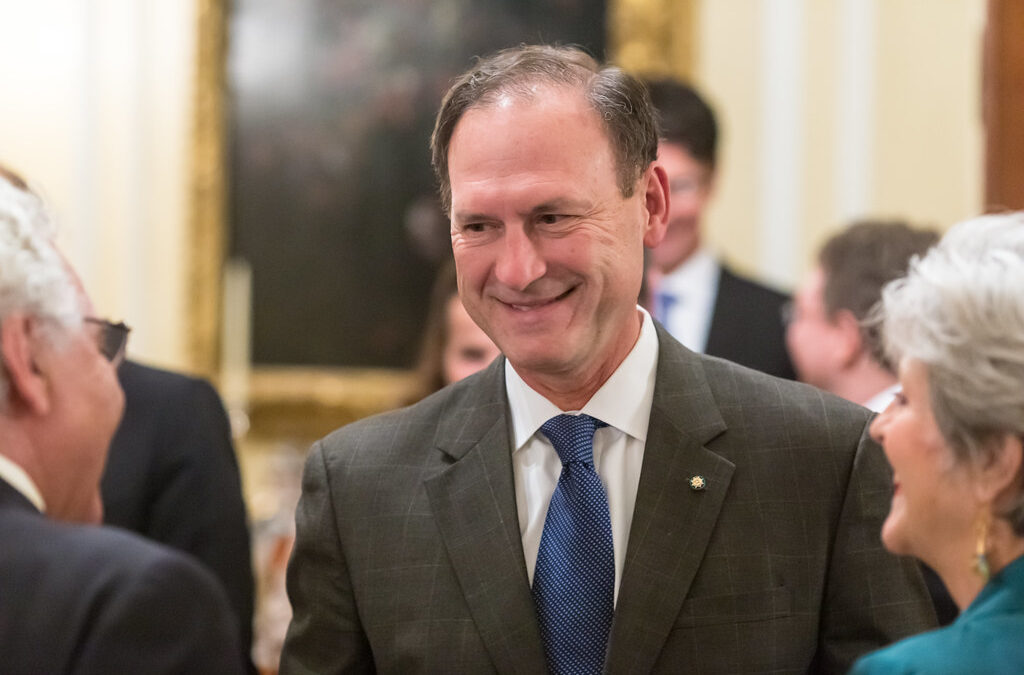
Supreme Court Justice Samuel Alito sat down with Mollie Hemingway, editor-in-chief at the Federalist, for a fireside chat after the Antonin Scalia Memorial Dinner at the Federalist Society’s 2026 National Lawyers Convention in Washington, DC.
He skipped the retirement chatter. Instead, Alito ticked off three principles he says the country has to guard with everything it has: free speech, religious liberty, and racial equality.
“I’m not saying we’re entering the dark age, but these are things that we have to preserve no matter what the atmosphere is in the country or the world at the time,” Alito said.
The atmosphere he had in mind isn’t hard to read. Voters handed Democrats both chambers of Congress, with Republicans losing 42 House seats and eight Senate seats while Alaska’s Senate race still sits uncalled.
Eight of the incoming lawmakers carry the backing of the Democratic Socialists of America, an openly Marxist outfit that wants government ownership of major corporations. And Democrat committee hopefuls already sound like prosecutors drawing up a witness list for the Trump team.
Toss in the Iran war the neocons sold as quick and tidy, plus the gas and grocery prices that climbed right along with it, and Washington feels about as cheerful as a tax audit.
Alito started with speech. He warned that “you cannot have Democratic self-fulfillment if you cannot have robust free speech,” and he made clear the protection covers the stuff that stings.
“Even speech that is hurtful to some of the people who hear what is being said,” Alito said.
Somebody ought to mail that line to every Democrat who ever floated a hate speech law or leaned on Big Tech to bury a news story.
On religion, Alito sounded almost upbeat. “I think that we have placed religious liberty on a sounder footing than it was on 20, 25 years ago,” he said, with two more religious freedom cases, St Mary Catholic Parish v Roy and Grand v City of University Heights, waiting on the Court’s docket this term.
But the third principle carries the sharpest edge for the two years ahead.
Martin Luther King’s Dream Became a Line the Left Won’t Walk Anymore
Alito called racial equality “essential for our pluralistic society.”
He tied it straight to Martin Luther King’s speech at the Lincoln Memorial and King’s hope that children “would be judged by the content of their character and not by the color of their skin.”
“If we don’t hold to that principle, then I think the society is going to start to come apart,” Alito said.
Funny how times change. A generation ago, liberal politicians quoted King’s line at every banquet that would have them. Today the Left’s favorite intellectuals treat a colorblind standard like a relic from a dusty attic.
Ibram X Kendi, the darling of corporate diversity seminars, put the new creed in writing. “The only remedy to past discrimination is present discrimination,” Kendi wrote in How to Be an Antiracist.
And the Supreme Court’s conservatives answered that thinking head-on in 2023, when Students for Fair Admissions v Harvard ended racial preferences in college admissions. Chief Justice John Roberts boiled it down to one sentence: “Eliminating racial discrimination means eliminating all of it.”
The Court’s liberal wing wanted no part of it. Justice Sonia Sotomayor wrote in dissent that “ignoring race will not equalize a society that is racially unequal,” and Justice Ketanji Brown Jackson insisted that “deeming race irrelevant in law does not make it so in life.”
Read those lines again with King’s dream sitting next to them. One side wants kids judged as individuals. The other side wants a racial ledger kept forever.
Montgomery County Parents Caught the Left’s Workaround
Alito didn’t need to name it, but the next test of that principle already sits on his docket.
The Court agreed in October to hear Association for Education Fairness v Montgomery County Board of Education. A group of mostly Asian-American parents in a Maryland county outside the nation’s capital sued in 2020, claiming the school district rewrote admissions to four selective magnet middle schools to shrink the number of Asian-American kids in them.
The district’s earlier overhaul dropped teacher recommendations and compared students only against classmates at their own local school. Then, starting in the 2021-22 school year, the county tossed qualified fifth graders into a lottery, a setup some call the Pandemic Plan.
The school board insists the lottery treats every child the same, and the county says Asian-American students win admission at a higher rate than any other group. Its lawyers called the dispute “unremarkable and of little significance” when they begged the justices to stay out of it.
But the parents point to a paper trail. According to the parent group, the district hired a national consulting firm back in 2015 to recommend ways to make the system more “equitable,” and that word has never meant fairer for Asian kids in any school board meeting in America.
“The Constitution protects students as individuals, not as members of a racial group,” said Chris Kieser, a senior attorney at Pacific Legal Foundation, which represents the parents.
Maybe the board really did just want a simple lottery during a chaotic pandemic year. Maybe. But a lottery makes a handy disguise when a district wants different racial numbers and can’t say so out loud anymore.
The justices will decide whether parents fighting a policy that looks neutral on paper must first prove their kids’ whole racial group lost ground compared with its share of applicants. Lower courts tossed the case on exactly that point. The Montgomery County branch of the NAACP and a coalition of left-wing groups lined up behind the school board.
Why Alito’s Warning Lands on the Democrat Majority’s Doorstep
Democrats never let go of the race-conscious playbook. Joe Biden signed an executive order on Advancing Racial Equity on his very first day in office in January 2021, and President Trump scrapped it when he returned to the White House.
Now the new Democrat majority gets the purse strings. Expect hearings that treat colorblind admissions as a crisis, grant money with “equity” strings attached, and fresh pressure on government schools to find the next clever lottery.
And a party that keeps importing new voters by the millions, then sorts them into racial blocs at election time, has every reason to keep that spoils system humming.
President Trump’s veto pen blocks the boldest stuff through January 2029. So the Left’s real target sits across the street from the Capitol, in a marble building with nine chairs that Democrats would love to turn into 13.
History offers a warning about how long a bad idea can hang around once a court blesses it. In 1896, Justice John Marshall Harlan stood alone against Plessy v Ferguson and wrote that “our Constitution is color-blind, and neither knows nor tolerates classes among citizens.” The Court needed 58 years to catch up with him.
Alito clearly has no interest in watching the country lose another 58 years.
So when the Montgomery County parents finally get their day before the justices early next year, will the party that once marched behind King’s dream stand with kids judged by their character, or with a school board the parents say quietly rigged a lottery against their children?
Sources:
Fox News, “Justice Alito warns America must preserve 3 core principles regardless of country’s ‘atmosphere’”
SCOTUSblog, “Justices take up case on race and school admissions”
The Daily Signal, “Supreme Court Takes Up Major New Battle Over Race in School Admissions”
Maryland Matters, “Supreme Court takes Montgomery County magnet school admissions case”
Reason, “Supreme Court takes up accusations of race-based middle school admissions”
NAACP Legal Defense Fund, statement on Association for Education Fairness v Montgomery County Board of Education
Supreme Court of the United States, Students for Fair Admissions v President and Fellows of Harvard College (2023)
Supreme Court of the United States, Plessy v Ferguson (1896), Harlan dissent
Ibram X Kendi, How to Be an Antiracist
Stay connected