
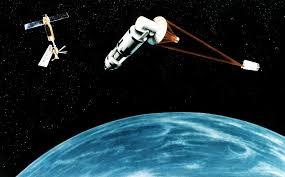
The Defense Intelligence Agency warned that America’s enemies are turning space into a shooting gallery aimed at the satellites your life runs on.
A 1967 treaty was supposed to keep the worst weapons out of orbit.
And the agency flagged one doomsday nuke that could blind the sky overnight.
Moscow’s Orbital Bomb Just Graduated From Rumor to Official Assessment
The Defense Intelligence Agency, the Pentagon’s military intelligence shop, put out its unclassified report Challenges to Security in Space 2026 in late October. It’s the third edition of the series, and the intelligence inside runs through July 2026.
The agency didn’t tuck its scariest finding on page 90 either.
“Russia is developing a satellite designed to carry a nuclear weapon,” the assessment states.
Then the report sketched the damage. “A space-based capability such as this could cause rapid and sudden loss or degradation of thousands of satellites operated by countries and companies around the world,” it warns.
Thousands isn’t a figure of speech. An agency graphic counts more than 15,000 satellites working in low-Earth orbit alone.
According to the report, Moscow could tailor a nuclear blast to reach satellites in most orbits. Think about what rides on those machines. The GPS signal steering a farmer’s tractor down a straight row. The timing signals banks lean on to clear a transaction. The weather satellites that tell a family on the Gulf Coast when to board up the windows.
And every bit of it would sit inside the blast zone.
The Soviet Union signed the 1967 Outer Space Treaty, which bans nuclear weapons from orbit. And Moscow inherited that promise. The agency says Russia is chasing the weapon anyway, though it reports the satellite remains under development for now.
The report lays the threat out like a ladder. The bottom rungs hold attacks that briefly scramble a satellite without wrecking it. Cyber strikes and orbital attacks come next, then missiles that physically smash a target. A nuclear detonation in space sits at the very top.
The Experts Swore Moscow Only Wanted a Power Plant
Folks heard rumblings about this weapon before. In February 2024, then-House Intelligence Committee Chairman Mike Turner (R-OH) publicly pressed the Biden administration to declassify intelligence about a “serious national security threat.” The details soon pointed to Russian nuclear work in orbit.
The Kremlin called the warning a “malicious fabrication.”
But Moscow’s denials weren’t the only fog. Plenty of analysts floated a gentler theory at the time, telling reporters that Russia probably wanted a satellite running on a nuclear reactor, something a lot less frightening than a warhead.
The new assessment slams that door. In the agency’s telling, Moscow wants a satellite that carries a nuclear weapon. Full stop.
The report also mentions Cosmos 2553, a satellite Russia launched in February 2022. Moscow claimed it would test how space radiation affects electronic parts. Readers can decide for themselves how innocent that sounds sitting beside the rest of this report.
And it’s worth remembering how the public first heard any of this. The Biden White House didn’t call a press conference. A Republican chairman had to demand declassification out loud to drag the threat into daylight. That same administration found plenty of time to lean on social media companies over so-called misinformation while the intelligence on a nuclear threat in orbit sat in a classified drawer.
One Summer Night in 1962 Already Showed What a Space Nuke Does
But nobody has to guess what happens when a nuke goes off above the atmosphere. The United States ran the experiment.
On July 9, 1962, an American Thor missile lifted a 1.4-megaton warhead off Johnston Atoll in the Pacific, and the warhead detonated about 250 miles up. Military planners called the test Starfish Prime.
Its electromagnetic pulse reached Hawaii, roughly 900 miles away. The pulse knocked out about 300 streetlights, set off burglar alarms, and damaged a telephone company microwave link.
And the satellites fared worse. Starfish Prime damaged at least a third of the 24 satellites circling Earth at the time, according to Lawrence Livermore computational physicist David Larson. Larson told APS News that the charged particles from such a blast can “become trapped in the Earth’s field, and they’re deadly for satellites.”
One of the casualties carried a famous name. AT&T launched Telstar the day after the blast, and the satellite relayed television pictures and phone calls until Starfish radiation chewed through its transistors. Plenty of readers still remember the Tornados’ 1962 instrumental hit that borrowed its name. Few remember that an American bomb helped finish off the real thing.
But here’s the part that should keep Washington up at night. In 1962, two dozen satellites made easy pickings. Today the count in low orbit alone runs past 15,000, and modern life leans on nearly every one of them.
Communist China and Two Rogue Regimes Want Their Own Piece of the Sky
Moscow isn’t working alone. “China, Russia, Iran, and North Korea are developing, testing, deploying, and using space capabilities in a way that threatens the security of all space systems and their associated space benefits,” the report states.
Communist China and Russia are both building satellite-killing missiles, jammers, and cyber weapons, according to the agency. A Space Force fact sheet adds that the agency judges Beijing’s military probably intends to field anti-satellite weapons able to reach geostationary orbit, roughly 22,000 miles up. That high perch holds many of the communications satellites Americans never think about.
Russia already rehearses the moves. In May 2026, Moscow steered four military satellites close to a Western commercial radar satellite that Ukraine uses for imagery, according to the Space Force.
The report puts Iran on its list too. That’s a fair reason to keep a close eye on Tehran’s rocket program. But it’s no excuse for the interventionist crowd in Washington to dust off another war plan. President Trump’s push to negotiate an end to the conflict with Iran cools down the one region where a rocket program and a grudge could turn ugly fastest.
The Peace Push Just Became the Best Satellite Defense Money Can’t Buy
The American intelligence community’s own 2026 Annual Threat Assessment named the scenario that should worry everyone most. “The most dangerous threat posed by Russia to the U.S. is an escalatory spiral in an ongoing conflict such as Ukraine or a new conflict that led to direct hostilities, including nuclear exchanges,” the assessment stated, according to the Congressional Research Service.
Put that line next to the agency’s ladder. A cornered Moscow holding an orbital nuke would have a way to black out the West without lobbing a single warhead at an American city.
That’s why the neoconservatives and globalists who have pushed for confrontation with Russia for more than a decade owe voters an answer. Every new long-range weapon they demand and every round of escalation they cheer nudges the world one rung higher. Trump promised to end the war in Ukraine. Bringing it to a close may do more to protect American satellites than any treaty ever signed.
Maybe Moscow only wants the weapon as a bargaining chip, something to wave around at the negotiating table. Maybe. But a bargaining chip that can wipe out thousands of satellites still has to sit somewhere, and somebody still has a finger near the button.
The treaty lesson writes itself. The Outer Space Treaty has stood since 1967, and it never stopped the Kremlin from drawing up this satellite. Paper only binds the governments willing to honor it.
America’s readiness has holes of its own. An American Foreign Policy Council report in April 2026 found that US decision-makers still lack clear guidance, legal clarity, and operational plans for a nuclear crisis in space.
And remember who saw the space fight coming. Trump launched the Space Force in his first term, and the left-wing comedy crowd treated it like a punch line. Netflix even built a sitcom, Space Force, around mocking the idea.
Whether the incoming Democrat majority in the House funds space defense as seriously as it funds its subpoena wish list remains an open question.
One American test in 1962 crippled roughly a third of the satellites in orbit. More than 15,000 now crowd low-Earth orbit alone.
Sources: Defense Intelligence Agency, Challenges to Security in Space 2026; Space.com; Fox News; US Space Force, Space Threat Fact Sheet; The Debrief; The Defense News; Minute Mirror; The Jerusalem Post/Reuters; Congressional Research Service, Russia’s Nuclear Weapons (April 2026); Defense News; APS News; Smithsonian Magazine; Scientific American
Stay connected