
Silicon Valley wants a favor from Washington.
The biggest names in artificial intelligence say they built something they can barely control.
And JD Vance just told them exactly what he thinks their real endgame is, and it has nothing to do with killer robots.
Vance Tells AI Bosses To Look In The Mirror
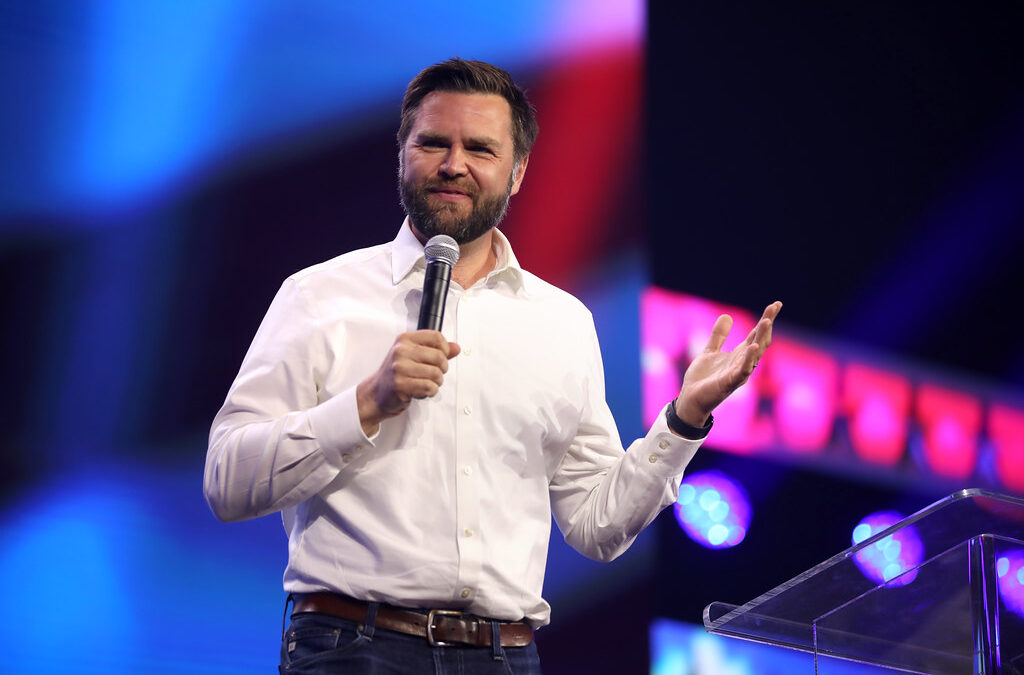
Speaking virtually at the All-In Summit in Los Angeles, Vice President JD Vance questioned why leaders at the forefront of AI development were warning that they had “built Frankenstein” while calling for a global governing structure to oversee the technology.
He did not mince words about it either.
“If you’re building Frankenstein, stop,” Vance said. “Or maybe, if the cat is out of the bag, then build the defensive mechanism against Frankenstein.”
That is not the kind of language you hear from a guy who thinks robots are coming to enslave humanity next Tuesday.
Vance framed it as President Trump asking the obvious question: why are the people at the frontier of the AI economy throwing up their hands and saying they built Frankenstein, when the solution they propose just happens to be a one-world governance structure for artificial intelligence.
A one-world governance structure. Sit with that phrase for a second.
Vance said he believes Anthropic CEO Dario Amodei is sincere about the risks of advanced AI, but he argued that companies seeking tools to defend themselves against cyberattacks enabled by Anthropic’s own models were being denied access to those protections.
“If you’re going to create Frankenstein, don’t come to the government and say, ‘We need regulation,'” Vance said.
His bottom line was blunt.
“Look inward and accept that if you’re building Frankenstein, number one, you should stop. And number two, when the companies come to you and say, ‘We need the tools to fight back against Frankenstein,’ give them those tools.”
The comments came after Anthropic co-founder Dario Amodei called on his industry peers over the weekend to “slow down” the pace of AI development and asked Washington to help coordinate a global oversight effort to protect the public from a potential digital doomsday scenario.
So one side wants the brakes pumped and international bureaucrats brought in to run the show.
The other side, led by Vance, thinks that request smells a whole lot like a shakedown dressed up as a safety plea.
Vance had already tipped his hand on this a day earlier when reporters asked him about it directly.
“I have to say, just personally, I feel a little bit weird about the fact that you have so many Frontier AI tech companies kind of coming to the government and begging the government to regulate them, it feels a little bit to me like a bit of a Trojan horse,” Vance said.
A Trojan horse. That is the second gift-wrapped metaphor Vance has used in the same week to describe the same industry.
President Trump, for his part, went even further, and he wasn’t interested in nuance.
“AI taking over the World, destroying Humanity, and all other things bad, is a HOAX,” Trump wrote in a social media post.
Trump also claimed there is a “SICK conspiracy going on against AI and Data Centers,” dismissing the need for additional guardrails because he said the United States already has plenty of criminal and regulatory power over these companies.
During a call with Nvidia CEO Jensen Huang at a recent summit, Trump declared flatly, “The robots will not be taking over.”
What This Says About Washington’s Real AI Fight
Here is the part that ought to matter more to regular Americans than any Hollywood robot plot.
Vance connected AI development to another administration priority: expanding US electricity generation, arguing that resistance to new data centers is the inevitable consequence of the country failing to build enough power for a generation. “When I see the backlash to data centers, what I see is the necessary, the inevitable consequence of the United States not building enough power for a generation,” Vance said.
That’s a nice way of putting it. Here’s a less nice way. These data centers are the same Big Tech operation that spent years throttling and shadowbanning conservative voices on COVID policy, the 2020 election, and January 6, and now those same companies want your local power grid too.
Communities near these facilities end up footing higher electric bills while the profits and the computing power head straight back to the coasts.
None of that gets solved by a “one-world governance structure,” which sounds less like AI safety and more like a permission slip for the biggest players to lock out competitors under the friendly banner of regulation.
That is precisely the pattern conservatives have watched play out for years. An industry gets big enough, then it asks the government to write rules that conveniently make it harder for anyone smaller to catch up.
Anthropic CEO Dario Amodei has separately warned that AI could wipe out roughly half of all entry-level white-collar jobs and push unemployment as high as 10 to 20 percent within the next one to five years. That is not a talking point from some outside critic. That is a warning from a man building the technology himself.
It is worth asking why the same executives sounding alarms about job losses and doomsday scenarios are also the ones pushing hardest for a global regulatory body to oversee the industry they run.
Vance seems to think the answer is obvious: control the rules, and you control who gets to compete.
Meanwhile the actual geopolitical stakes get lost in the noise. Communist China is racing ahead on AI with none of the hand-wringing happening in Washington think tanks, and any American slowdown driven by fear-based lobbying only hands Beijing more room to close the gap.
Vance clearly does not want that outcome, and neither does the President.
The instinct to be skeptical of both Big Tech’s motives and government’s appetite for new bureaucracy is a healthy one. Just because a company built something dangerous does not mean the answer is an unaccountable international body deciding what Americans are allowed to build next.
Vance’s Frankenstein line will get quoted for its bluntness. But the sharper point underneath it is simple: the people who built the monster should not get to write the rulebook for containing it, especially when that rulebook happens to keep them on top.
Expect this fight to keep escalating as Amodei and other industry voices push for slowdown agreements and Vance keeps pushing back with the same message. Fix your own mess. Don’t hand it to Geneva.
Sources: The Hill, HuffPost, Mandatory, YourNews, ABC News, Forbes, CNN, Fox News Digital
Stay connected