
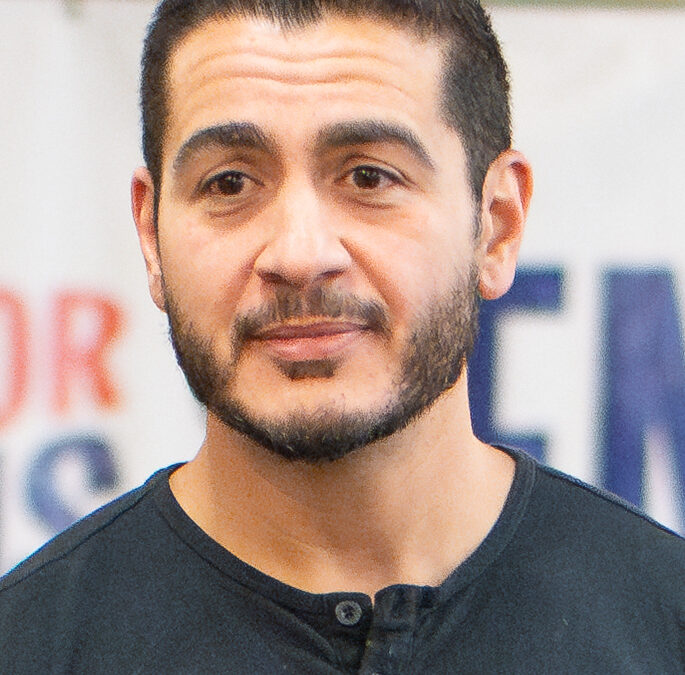

Democrats picked a self-described socialist to run for Michigan’s open Senate seat.
Republicans are going door to door trying to make sure voters know it.
But what they found knocking on suburban Detroit porches may be the real story heading into November.
The Pitch at the Door
The message Republican canvassers carried into Livonia, Michigan was direct: US Senate candidate Mike Rogers is a common-sense conservative, and his Democrat rival Abdul El-Sayed is a big-government socialist aligned with the party’s left wing.
Americans for Prosperity Action, the super PAC arm of the conservative network backed by billionaire Charles Koch, sent door-knockers through the suburban Detroit area in recent weeks to mobilize low-propensity voters for Rogers in what has become a tightly contested race.
El-Sayed isn’t hiding what he is. His own campaign website promises to “pass Medicare for All” and frames the race as a fight against “Elon Musk, Donald Trump, or their billionaire friends.” That’s not a moderate running to the center. That’s a socialist running on a socialist platform, and the Republicans walking those precincts have a real case to make.
But when one canvasser brought that case to Nick Delise, a three-time Donald Trump voter in suburban Detroit, he ran into some skepticism. Delise said he would probably vote for Rogers. He also rejected the notion that Democrats were controlled by the far left, saying the party was focused on practical solutions to voters’ problems.
Delise, 32, knew little about either candidate and acknowledged he typically skips midterm elections. An American flag hung from his porch. Two pickup trucks sat in the driveway. A pro-police “Thin Blue Line” banner hung in the garage. He complained about the cost of fueling his trucks.
And he may not show up in November.
What El-Sayed Actually Represents
El-Sayed won the Democrat primary after a heated contest that saw him edge out Representative Haley Stevens with 48.5% of the vote. US Senator Bernie Sanders endorsed him, calling him a physician who “supports Medicare for All.”
That’s not a label Republicans invented. That’s who the Democrat Party of Michigan chose to represent them.
Government-run healthcare of the Medicare for All variety means rationing, bureaucratic delay, and the erosion of the patient-doctor relationship that made American medicine worth defending. Countries that run centralized healthcare systems pile up wait times and shortages. El-Sayed’s own website makes no secret of his support for that kind of federal control over medicine. Voters who care about keeping their doctors and their choices should take him at his word.
After El-Sayed won the primary, Rogers released a statement characterizing the race as a choice between “common sense or complete insanity,” calling El-Sayed an “extremist” who was “leading a movement grounded in ideological fanaticism.”
And then after El-Sayed won, Chuck Schumer and other top Democrats moved to embrace the progressive winner rather than withhold support — a sharp contrast to how the Republican establishment has treated its own MAGA-aligned primary winners in other states.
The Enthusiasm Problem Republicans Need to Solve
Michigan is the only open Democrat-held Senate seat in a state President Trump won in 2024. Republicans have not won a Senate race in Michigan since 1994. This is the kind of race that flips chambers, or doesn’t, depending on who shows up.
Recent polling shows the race is effectively tied or slightly tilted toward El-Sayed. An AARP poll found the two candidates deadlocked at 48% to 47% among likely voters, within the margin of error. A Hill/Emerson College Polling survey found El-Sayed ahead 48% to 46%. A Fox News poll gave Rogers the edge at 51% to 47%, also within the margin of error.
But the number that matters for what those canvassers encountered on Delise’s porch: Republicans are trying to turn out voters who skipped the last midterm and barely track the names of the candidates they’re being asked to support.
Rogers’ campaign did not respond to a request for comment on the canvassing effort.
The enthusiasm dynamics complicate the picture. Democrats in Michigan are more engaged heading into November, even as Republicans show strong internal party support numbers for Rogers. Translating that support into actual turnout from low-propensity voters like Delise is the whole ballgame.
And that’s where the door-knocking strategy lives or dies. Nick Delise probably votes for Rogers. But “probably” doesn’t count on election night, and a man who skips midterms while complaining about gas prices isn’t automatically a reliable Republican vote just because he voted for Trump three times in presidential years.
What This Race Really Means
The Michigan Senate race represents something bigger than one state. El-Sayed is not a centrist who drifted slightly left. He’s a candidate who ran on government-controlled healthcare, built his campaign around opposition to the same voters who sent Trump back to Washington, and won a primary by beating a more establishment-friendly opponent. The Democrat Party base chose him on purpose.
And the Republican establishment response to races like this one tells a story too. Democrats coalesced around El-Sayed quickly after his primary win, with Michigan Governor Gretchen Whitmer and others signaling support. Meanwhile, the canvassing in suburban Detroit falls largely to outside groups like Americans for Prosperity Action rather than a unified national party apparatus running full-speed.
That gap matters. A grassroots argument delivered by a door-knocker with a leaflet is only as strong as the voter on the other side of the screen door is motivated to care.
El-Sayed’s platform — Medicare for All, opposition to “foreign wars,” hostility toward the energy companies that fuel the trucks Nick Delise can’t afford to fill — is precisely the kind of agenda that has failed everywhere it has been tried. Socialism delivers shortages, not security. It delivers central planning, not choice. The historical record on government-run economies is not ambiguous, and Michigan voters who have watched their manufacturing base hollow out over decades should be the last people in America who need that lesson.
But facts don’t vote. People do.
The Rogers campaign and its allied groups have a narrow window to close the gap, not by changing their message, but by making sure the voters who already agree with them actually walk into a polling place. Every Nick Delise who says “probably” and stays home is a vote that didn’t get cast for the one candidate in this race who isn’t running on a platform designed to hand the federal government more control over Michigan’s economy, Michigan’s healthcare, and Michigan’s future.
The canvassers in Livonia understand what’s at stake. Whether enough Michigan voters understand it before November is still an open question.
Sources: Reuters via MSN, jpost.com, whbl.com; The Hill; Fox News; AARP Poll; Ballotpedia; Wikipedia, 2026 United States Senate election in Michigan; abdulforsenate.com
Stay connected