
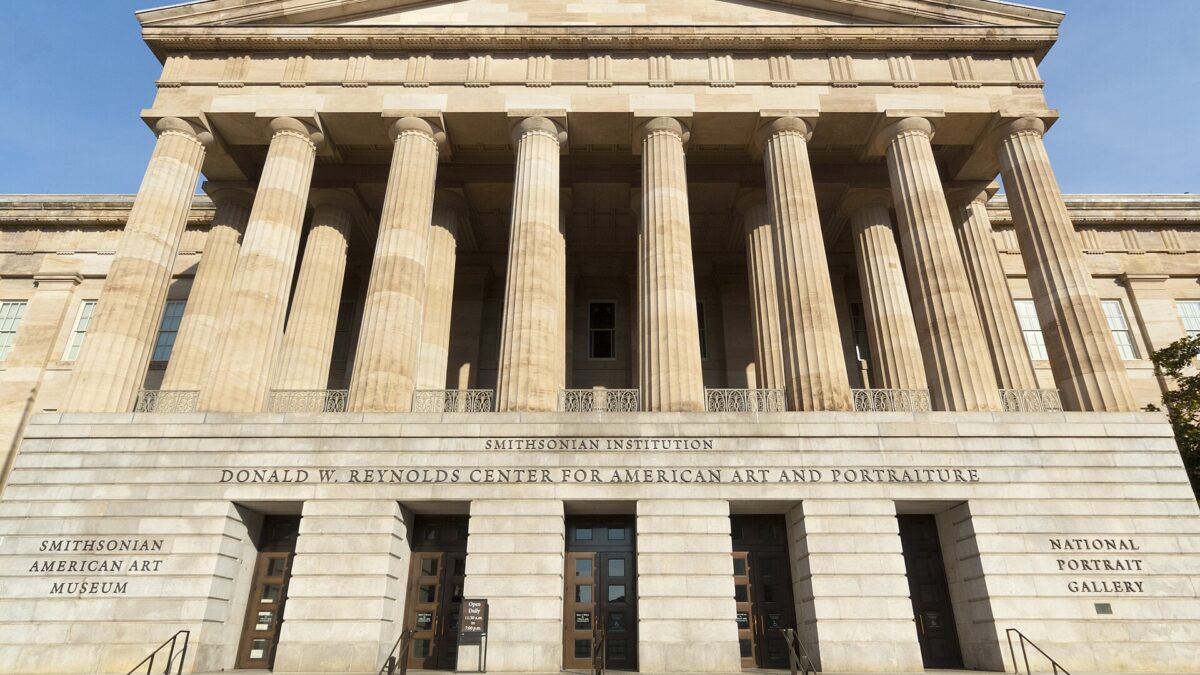

The Smithsonian’s flagship history museum has never been shy about pushing a political message.
President Trump warned museum leadership he was watching, and he made a promise months ago.
Now comes word of exactly how his administration plans to keep that promise, and Smithsonian brass will not enjoy the details.
Burgum’s Letter Spells Out the Sign Plan
Interior Secretary Doug Burgum revealed the plans in a Sept 3 letter to Sens Jeff Merkley (D-OR) and Lisa Murkowski (R-AK), who had sought details about the initiative after Trump ordered the signage in a July executive order. The letter finally puts real numbers and real language behind an idea Trump floated publicly for months.
The Interior Department is preparing about a dozen signs, expected to cost roughly $7,000 apiece. That works out to roughly $84,000 in taxpayer money to plant a dozen placards on National Park Service land right outside the museum’s doors.
The signs are not decorative. While the final wording has not yet been determined, the signs will provide visitors with “important context about the exhibits they are about to encounter and the personal viewpoints that the curators of the exhibits are seeking to advance,” according to Burgum’s letter.
Burgum did not soften his language when explaining why. “A commitment to public transparency means that visitors should be informed about Director Hartig’s and other Smithsonian leaders’ history of racial focus,” Burgum wrote.
He went further, naming names. He added that visitors should know about “Secretary Lonnie Bunch’s history of invidious discrimination and anti-white animus,” pointing to a 2000 essay in which Bunch discussed racial discrimination within the museum profession.
That is not a stray line buried in the letter. It is the entire point. A taxpayer-funded federal cabinet official just accused the outgoing Smithsonian secretary of anti-white discrimination on paper, in writing, addressed to two sitting United States senators.
The administration also singled out museum materials involving transgender Americans and terminology surrounding undocumented immigrants. None of that is a coincidence. It is a checklist of the exact ideological fault lines that have defined the culture war for the last decade.
What Started This Fight in the First Place
Trump ordered the signs after the White House issued a 162-page report on July 4 accusing the American History Museum and its director, Anthea Hartig, of promoting “extreme political activism.” That report did not come out of nowhere either.
Trump had already told the country exactly how he felt about the institution. “The Smithsonian is OUT OF CONTROL, where everything discussed is how horrible our Country is, how bad Slavery was, and how unaccomplished the downtrodden have been,” Trump wrote in a social media post.
Interior’s letter added more specifics on the record. Burgum’s letter complains that NMAH director Anthea Hartig “has stated that history is ‘a prime tool of social justice,'” and asserts that the museum is trying “to legitimize illegal immigration and open borders.” It does not get much more direct than that.
The letter also takes aim at how the museum treats basic biology. It accuses the museum of mounting exhibits that “present ideological viewpoints inconsistent with biology, including ideologies that sex is not binary.”
Burgum’s language leans on the same institutional justification museums always reach for. Burgum told the senators a “commitment to transparency” and “academic honesty” has forced the administration to erect signs outside the museum, warning visitors that “the leadership of the Smithsonian and NMAH have altered the museum’s role from accurately and coherently telling American’s story to using the museum as a tool to advance personal, radical ideologies.”
Bunch Is Heading Out the Door Anyway
The timing here is worth sitting with for a second. The mounting pressure comes as the Smithsonian prepares for a leadership transition. Bunch announced last week that he plans to retire. He told The Washington Post that his decision was unrelated to the administration’s pressure campaign, and he has defended the institution’s independence and its approach to presenting complex aspects of American history.
Bunch pushed back on the bias accusations directly in a message to his own staff over the summer. “At the Smithsonian, our work is driven by scholarship, accuracy and an uncompromising commitment to tell the fullness of America’s story,” Bunch wrote in his July letter to Smithsonian staffers.
Readers can decide for themselves whether that statement squares with a 2000 essay Bunch himself wrote about racial discrimination inside the museum profession, the same essay Burgum cited as evidence of anti-white animus. It is one thing to defend “the fullness of America’s story.” It is another to have a documented record cited by a sitting cabinet secretary in a formal letter to the United States Senate.
Institutional context matters here too. The Smithsonian receives both federal and private funding but is not an executive branch agency. It is governed by a Board of Regents that includes members of Congress, Chief Justice John G Roberts Jr, Vice President JD Vance and private citizens. Vance’s seat on that board means the administration has a direct line into how this all plays out going forward.
Why This Fight Was Always Coming
None of this should surprise anyone who has watched what happened to America’s cultural institutions over the last decade. Museums, universities and government agencies quietly rewrote their missions around DEI orthodoxy, and taxpayers footed the bill without ever being asked whether they wanted their national history museum treating “social justice” as a curatorial mandate.
Anti-white discrimination dressed up as equity has become standard practice across American institutions, and it is racism no matter which direction it points. A federal cabinet secretary putting that accusation in writing against a sitting Smithsonian secretary is not some fringe grievance. It is a recognition that the same civil rights standards Americans were promised decades ago apply to everyone, including the people running the Smithsonian.
The Smithsonian’s National Museum of American History is supposed to tell the story of a nation that, for all its imperfections, remains the freest and most exceptional experiment in self-governance the world has ever produced. When curators instead treat every exhibit as an opportunity to indict the country rather than explain it, taxpayers have every right to demand transparency about who is making those calls and why.
Bunch’s retirement will not end this fight. The next Smithsonian secretary inherits an institution under a microscope, a board that now includes JD Vance, and a White House that has shown it is willing to spend $84,000 in taxpayer money just to make sure visitors know exactly whose “personal viewpoints” they are walking past. That pressure campaign is not going away just because one man is stepping down.
Trump made a promise this summer to hold the Smithsonian accountable for the story it tells about America. Burgum’s letter shows the administration intends to follow through, sign by sign, museum by museum, for as long as it takes.
Sources: The Atlantic; Mediaite, “Trump Reportedly Planning to Put Signs Outside the Smithsonian to ‘Publicly Shame’ Museum Leadership”; The Spokesman-Review; ArtNews; The Washington Post; NPR; The Center Square
Stay connected