
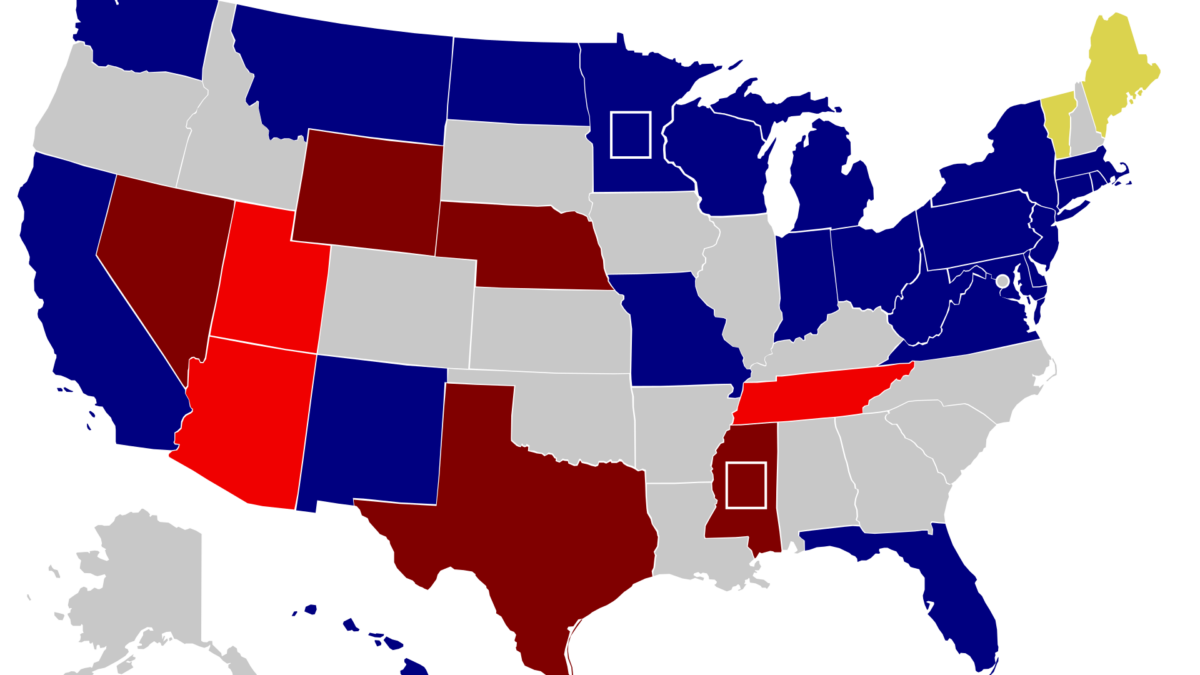

Democrats need to flip four Republican Senate seats to grab control of the chamber.
Republicans swear their firewall holds, but six races are running neck and neck.
And Donald Trump’s majority could hinge on one race where the ballot itself is under investigation.
The Math Democrats Have to Pull Off
Start with the arithmetic, because everything on election night flows from it.
Republicans control the Senate, and Vice President JD Vance breaks any tie. That means Democrats need a net gain of four seats to take the gavel and the committee chairmanships that come with it.
Six races will decide whether they get there. Five of them sit in Republican hands: Alaska, Ohio, Maine, Kansas, and Texas. The sixth, Michigan, belongs to Democrats, with US Senator Gary Peters (D-MI) retiring.
So the Democrat path is narrow. They have to hold Michigan and win four of the other five. Lose Michigan, and they need to sweep nearly everything else.
But narrow doesn’t mean impossible. Heading into the final weekend, Democrats led the RealClearPolling average in every one of those six races, most of them by less than three points. That’s coin-flip territory, and coin flips have a nasty habit of landing the same way all night in a wave year.
Here’s the order to watch them in, from the first polls to close to the last.
Ohio and Maine Will Set the Tone Early
Ohio closes first, and it’s the earliest sign of what kind of night Republicans are in for.
US Senator Jon Husted (R-OH) took the seat JD Vance gave up to become Vice President. Former US Senator Sherrod Brown (D-OH) wants his old job back and led by an average of 2.6 points.
Think about that for a second. Donald Trump carried Ohio by about 11 points in 2024. If Brown wins there, Democrats are probably having the kind of night that reaches deep into red country. If Husted holds, the wave talk cools off fast.
Maine comes next. US Senator Susan Collins (R-ME) has won five Senate races since 1996 in a state that went for Kamala Harris by about seven points. Democrat Troy Jackson jumped in late, after the original nominee quit, and held a 1.4-point average lead.
Heating oil may decide this one. Prices across Maine hit $6.05 a gallon, and roughly half the state heats with oil through the winter. Collins voted five times to extend US military operations in Iran, then joined US Senator Angus King (I-ME) in pressing the Trump administration to tap the Northeast Home Heating Oil Reserve before the election.
Collins has beaten bad polls before. Whether she can beat a $6 fill-up is another question.
Michigan Is the One Democrats Can’t Afford to Lose
Michigan is the only seat on the board that Democrats have to defend, and it may be the night’s best test of how far left the party can run in a swing state.
Abdul El-Sayed, a political newcomer and former public health official, beat Congresswoman Haley Stevens (D-MI) by a single point in the primary with endorsements from US Senator Bernie Sanders (I-VT), Congresswoman Alexandria Ocasio-Cortez (D-NY), and Congresswoman Rashida Tlaib (D-MI). He ran on affordability and fighting corporate money while backing a cutoff of aid to Israel. That’s the brand of left-wing populism the media loves, and Michigan will show whether it sells outside the college towns where El-Sayed ran strongest in August.
Former Congressman Mike Rogers (R-MI) carries Trump’s endorsement, and he lost to US Senator Elissa Slotkin (D-MI) by roughly 19,000 votes in 2024. But Rogers spent the final stretch putting distance between himself and the President. On August 29, he called Trump’s tariffs “necessary.” By October, he was sitting in a bar with a Labatt, telling voters to “end this tariff war now.” He also went from calling US action against Iran a “win-win-win” to saying the war had to end to bring prices down.
El-Sayed led by 3.2 points. Trump won Michigan by one point in 2024. Watch the working-class, non-college counties where Stevens beat El-Sayed in the primary. If he can’t win those voters back, Republicans have a shot at a pickup that would wreck the Democrat math.
Texas and Kansas Test How Deep the Red Runs
And then comes the part of the map nobody expected to be competitive.
Texas hasn’t sent a Democrat to the Senate since 1993. Attorney General Ken Paxton beat US Senator John Cornyn (R-TX) by 28 points in the primary after Trump endorsed him late. Now state Rep James Talarico held a 1.8-point average lead.
Republicans have poured more than $300 million into the race. Democrats have spent more than $130 million in ads.
Talarico’s campaign hammered Paxton on corruption. The Republican-controlled state House impeached Paxton in 2023 on bribery and abuse of power charges, and the state Senate acquitted him. Paxton has denied all wrongdoing.
But Talarico brings his own baggage into a state like Texas. He said in 2021 that God was “non-binary,” argued that the biblical account of Jesus’ conception justified abortion, and claimed transgender children were made in God’s image. He also left the campaign trail for nine days in early October, citing what he called a “nasty case of the flu.”
Kansas might be the biggest shock on the board. Kansas hasn’t elected a Democrat to the Senate since the 1930s, yet Democrat Adam Hamilton led US Senator Roger Marshall (R-KS) by 2.6 points.
The New York Times reported that Marshall, during his years as an OB-GYN, sued 700 patients over unpaid bills, which led to 81 arrests. Diesel near $6.03 a gallon has farmers furious. Marshall blames the war in Ukraine, and Hamilton blames Trump and the Iran war. Senate Republicans’ main super PAC dropped $14 million to protect a seat that normally takes care of itself.
Alaska Could Keep Everybody Up Past Midnight
Alaska closes last, and it could turn out to be the race that decides everything.
Former Congresswoman Mary Peltola (D-AK) is challenging US Senator Dan Sullivan (R-AK), and she led by 1.2 points. But a second Dan Sullivan, a former schoolteacher named Dan J Sullivan, also appears on the ballot.
According to the New York Times, aides tied to Peltola’s team and the Democrat Senate campaign arm worked with operative Jerid Kurtz to recruit Republicans to run against Sullivan. Alaska’s own elections director wrote that Dan J Sullivan’s filing “was not filed in order to declare an actual good-faith candidacy.” Peltola’s side has denied involvement, and no one has faced charges.
The Justice Department subpoenaed more than three dozen people. Governor Mike Dunleavy (R-AK) ordered the Department of Public Safety to investigate. And Dan J Sullivan switched his party label from Republican to unaffiliated in the last week of the campaign.
Alaska also counts slowly, so a close race there could drag on long after the rest of the country goes to bed.
What the Night Tells Voters Either Way
Whatever happens, the stakes go well past six names on six ballots.
A Democrat Senate would control which judges get hearings, which Trump nominees reach the floor, and which committees start firing off subpoenas in 2027. A Republican hold keeps those gavels where they sit for two more years.
The early returns from Ohio and Maine will hint at the shape of the night. Michigan will show whether Republicans can play offense. Texas and Kansas will show how deep the trouble runs in places Republicans used to take for granted.
So if control of the Senate comes down to Alaska, how many votes will the second Dan Sullivan collect, and will anybody be able to say which Sullivan those voters meant to choose?
Sources: The Daily Caller, “Midterm Election Watch Guide: When GOP Will Know If It’s Time To Hit Panic Button Or Reach For Champagne” (Nicole Silverio); Axios, “Michigan Senate hopeful Rogers distances himself from Trump”; Reuters via GV Wire, “Michigan Republican Rogers Calls for End to Canada Tariff Fight, Breaking With Trump Again”; The Boston Globe, “Michigan Republican faces pressure during heated debate on Trump’s Canada tariffs”; The Hill via Denver Gazette, “Mike Rogers breaks with Trump on tariffs in new ad”
Stay connected