

Chuck Schumer’s socialist challengers swear the fight for his Senate leadership job is a war for the soul of the Democrat Party.
Cable news is covering the con job like a title bout.
And Hillary Clinton, of all people, just let voters in on what the brawl is really about.
Hillary Clinton Rang the Bell on Schumer’s Title Fight
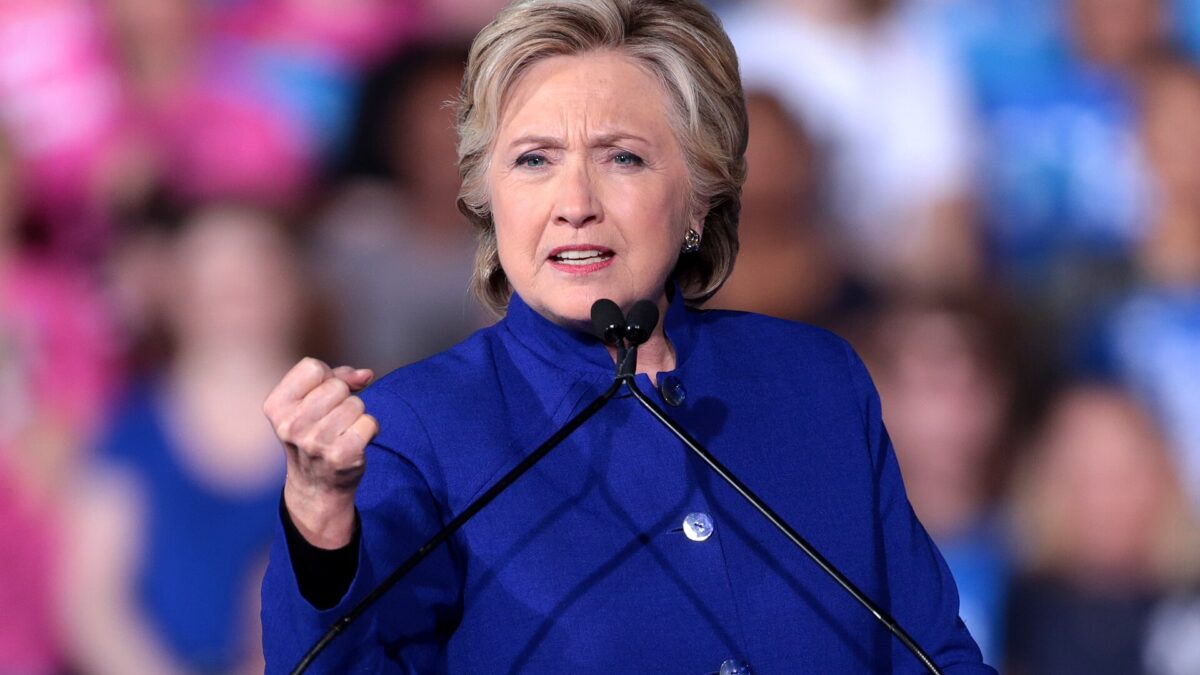
Hillary Clinton and Kara Swisher sat down for an episode of their podcast, High Stakes, and Swisher wanted Clinton’s take on the challenge US Senator Chris Van Hollen (D-MD) launched against Senate Minority Leader Chuck Schumer (D-NY).
Clinton skipped the usual throat-clearing.
“So, this leadership battle, to me, is kind of performance, in a way,” Clinton said.
Performance. The most famous establishment Democrat in America picked that word for the uprising the far left has cheered on cable and podcasts for weeks.
Van Hollen announced his run on November 12, pointing to the midterm results as a call for change. His corner includes US Senator Bernie Sanders (I-VT), US Senator Jeff Merkley (D-OR), and two incoming senators, Abdul El-Sayed and Peggy Flanagan, whom Schumer didn’t back at the start of their races. Schumer counts 15 senators in his camp so far, according to Fox News Digital, and he posted that he has “the votes to continue serving as Democratic leader.”
When Swisher asked whether Schumer would survive, Clinton didn’t hesitate. “Yeah, I do,” she said.
The Example Hillary Picked Gives the Whole Game Away
But the prediction matters less than what came before it, when Clinton described what a majority leader actually does.
The job, she said, is “to push the committees, to mark up legislation, get it on the floor, get it passed.”
Then she acted out a little scene, playing the part of the leader. “OK, Abdul, you want to put in Medicare-for-all, and Adam Hamilton, that’s not your preferred approach,” Clinton said. Her imaginary leader then sends them both to work with the legislative team, “and let’s figure out how we’re going to get something passed.”
Notice what never comes up in that skit.
Nobody in Hillary’s Senate asks whether Washington should take over the country’s health insurance. The leader’s only task is to figure out how much of the takeover the staff can squeeze through the chamber. El-Sayed brings the single-payer dream, the “moderate” haggles over the size, and the legislative team writes the compromise.
And there sits the whole leadership fight in one podcast clip. Schumer’s camp and Van Hollen’s camp agree on where the party is headed. They’re brawling over whose name goes on the office door.
Kansas Sent Washington a Moderate Who Wants a Government Plan Too
Clinton’s choice of foil deserves a closer look.
Adam Hamilton, the Methodist pastor who unseated Republican Senator Roger Marshall in Kansas, sold voters on “leading from the middle.” He stayed registered as a Republican until earlier this year. And after the election, he told KCTV that if Schumer brings an idea that helps Kansas, “I’m all in.”
So what does the middle look like on health care? A government insurance plan. One health policy newsletter noted that Hamilton, James Talarico of Texas, and Annie Andrews of South Carolina passed on Medicare for All during their campaigns and instead favor a public option, a government-run plan the uninsured and employers could buy into.
That’s the big compromise. A smaller government plan in place of a bigger one.
The self-styled pragmatists at Majority Democrats are even pitching the public option as “a revolution rooted in reality,” according to Puck. A revolution. From the centrists.
Chuck Schumer Never Met a Government Plan He Couldn’t Shrink to Fit
Schumer himself has played this game for a long time.
During the Obamacare fight in 2009, Schumer wrote his own public option amendment in the Senate Finance Committee, a slimmed-down version that wouldn’t tie the government plan to Medicare rates. In December 2018, when an MSNBC host pressed him on Medicare for All, Schumer rattled off the Democrat menu: “some are Medicare over 55, some are Medicaid buy-in, some are public option.”
The single-payer activists took it as a snub. But look at that list again. Every item on it hands Washington a bigger slice of the doctor’s office.
Schumer has spent his career serving the government takeover in smaller portions.
Barney Frank Explained Where the Small Portions Lead
Back in July 2009, a single-payer activist with a camera cornered then-Representative Barney Frank (D-MA) and asked why he wouldn’t push the real thing. Frank said Democrats didn’t have the votes. Then he explained that a strong public option “could lead to single payer,” and he called it the best route to get there.
Heritage Foundation health policy expert Nina Owcharenko Schaefer later gave the strategy a fitting name: “single payer on an installment plan.”
The math isn’t complicated. Taxpayers backstop the government plan. The government plan undercuts private premiums. Employers start dumping workers into it, private insurers shrink, and one day the “option” turns into the only game in town.
So when Clinton pictures El-Sayed and Hamilton hashing things out with the legislative team, picture the lump-sum plan and the installment plan sitting at the same table.
Hillary Clinton Once Promised This Day Would Never Come
In January 2016, Clinton stood in front of Iowa voters and called Sanders’ single-payer plan “some better idea that will never, ever come to pass.”
But Hillary’s forecasts tend to change with the weather. In 1994, while she pushed her own health care overhaul as First Lady, she told reporters that if Congress didn’t pass reform, the country would eventually embrace single payer, as CBS News later recalled.
Inevitable in 1994. Impossible in 2016. In 2026, it’s just another item waiting on the legislative team.
Maybe that’s leaning too hard on one example from one podcast. Clinton was talking about how a leader manages a caucus, not endorsing a bill. But out of every issue on the planet, she reached for socialized medicine, and she cast the senator who wants to wipe out private insurance as just another colleague with a different “preferred approach.”
El-Sayed has never hidden the goal. He said in July he wants whichever leader gives Democrats “the best shot at passing Medicare for all.” Van Hollen already cosponsors the Medicare for All Act. And under Clinton’s description of the job, a re-elected Schumer would hand El-Sayed a seat at the drafting table anyway.
Voters handed Democrats both chambers, and the socialist wing reads that result as a mandate. President Trump holds the veto pen until January 2029, so none of this becomes law on his watch. But a Common Dreams column already laid out the Left’s timetable, urging Democrats to lay the groundwork now “so it can become a reality in 2029 under a new president.”
That makes the next two years a dress rehearsal. Committees can mark up the bills, hearings can showcase the sob stories, and the public option crowd gets to look reasonable standing next to El-Sayed. Van Hollen has also floated a major change to Senate rules, and progressives have demanded the filibuster’s demise for years. Without it, the installment plan pays off in a single vote.
There’s a better road, and it doesn’t run through a committee room in Washington, DC. Health savings accounts put the money in the patient’s pocket. Direct primary care lets a family pay a doctor a flat monthly fee and skip the insurance company altogether. Letting insurers sell across state lines would give families more choices than their own state markets allow. Every country that let politicians run its health system learned the same lesson: when the government pays every bill, the government decides which bills get paid.
Clinton wants a leader with the experience to “pull those parliamentary levers.” She never said which direction he’d pull them.
In 2016, Hillary Clinton told Iowa that single payer would never, ever come to pass. In 2026, she described a Senate where it simply waits its turn on the committee calendar. Nobody on that podcast asked her which of those predictions she believes now.
Sources: Fox News, “Hillary Clinton dismisses Democratic leadership battle as a ‘performance’ as Schumer faces progressive revolt”; CBS News, “Hillary Clinton: Single-payer health care will ‘never, ever’ happen”; CBS News, Kansas Senate race coverage; KCTV, “Kansas Senator-elect Adam Hamilton pledges independent voice”; NPR, “Kansas just elected a Democrat. His message to Washington? Be decent”; Gooznews, “Budget hawk nonsense on Medicare for All”; Puck, Majority Democrats public option campaign; Common Dreams, Schumer Medicare for All coverage (2018), Working Families Party coverage, and “10 Reasons Chuck Schumer Should Not Be Senate Majority Leader”; The Independent Florida Alligator, 2009 Senate Finance public option votes; The Hill and The Daily Signal, Barney Frank 2009 remarks; Oklahoma Council of Public Affairs, citing Heritage Foundation’s Nina Owcharenko Schaefer; Townhall, El-Sayed July 2026 remarks.
Stay connected