
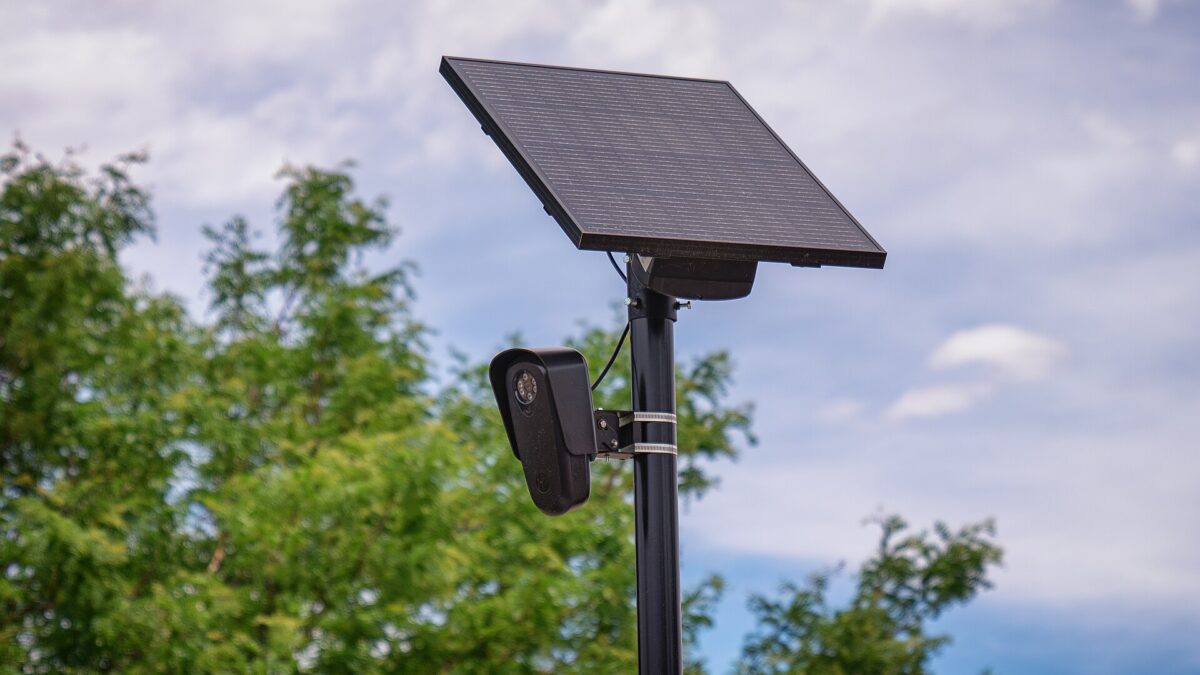

The government has been quietly building a nationwide tracking network, one camera at a time.
Ordinary Americans driving to work, to church, to their kids’ school have no idea how much data law enforcement already holds on their movements.
And now US Senator Josh Hawley (R-MO) just dropped a bill that puts the whole operation on notice — and the details are worse than most people imagine.
What Flock Safety Has Been Doing Without Your Knowledge
Flock Safety’s automated license plate reader network spans roughly 120,000 cameras across 49 states. The cameras record a vehicle’s make, model, color, and plate, time-stamping every pass through every reader.
That data gets retained, shared across jurisdictions, and queried by officers who, until recently, could type “lol” into the reason field for a search and face zero consequences.
The Institute for Justice catalogued more than 240 documented incidents of ALPR misuse. In Massachusetts, a police officer used Flock networks to stalk a former romantic partner who had changed her identity to escape his abuse.
In Kentucky, an officer allegedly searched his child’s mother’s vehicle location 1,000 times through Flock’s network — despite an active protective order against him. In North Carolina, a police officer allegedly accessed the Flock dataset to look up vehicles of undercover investigators at the request of a drug suspect.
Alasdair Whitney, legislative counsel for the Institute for Justice, testified before Hawley’s subcommittee that the abuses extend far beyond misidentifications. And the company itself, Flock Safety, acknowledged in a letter to Hawley that it does not maintain a single consolidated count of confirmed customer misuse. The company currently allows clients to store data for as long as they choose.
That’s not a guardrail. That’s an open door.
Flock Safety CEO Garrett Langley did write to the panel acknowledging that Congress should create a federal framework. The company’s own website states that “effective frameworks should preserve law enforcement’s ability to use an important public safety tool while requiring accountability, oversight and responsible data practices.” Hard to argue with that in principle. The problem is that Flock built a 120,000-camera empire first and got around to suggesting oversight later.
The Florida Woman Who Spent 86 Hours in Solitary Over a Camera Read
Lindsey Isaacs is 23 years old and lives in Palm Beach, Florida. In October 2025, she spent most of an evening at home. A fatal hit-and-run crash happened nearby. Witnesses described a Dodge Durango. Flock cameras captured a black Dodge Durango with a different plate approximately three miles from the scene — Isaacs’ vehicle.
Law enforcement impounded her undamaged car and, according to her federal lawsuit, allegedly fabricated reports of collision damage to secure a warrant. Seven months later, in April 2026, a warrant was issued.
She faced eight felony charges, including three counts of vehicular homicide. Prosecutors declined to pursue all eight charges in May 2026, and another woman, Alisa Lee Montalvo, was later arrested and charged with nine felonies arising from the same crash.
None of that helped Lindsey Isaacs during the 13 days she sat in custody. She testified before Hawley’s Senate Judiciary Subcommittee on Crime and Counterterrorism about what happened when she arrived at the jail.
“I was placed in a blue suicide prevention dress with a broken Velcro on the left side that left me exposed. The cell door was shut, and it was not opened for approximately 86 hours,” Isaacs testified. At her lowest point inside that cell, she said, she did not want to be alive.
“I was terrified I was facing the possibility of spending the rest of my life in prison for a crash that I knew I had not been involved in,” Isaacs told the senators.
Her attorney, Patrick McGeehan, a former police detective, summed up the situation plainly: “We have a situation where the technology’s evolving faster than we can control it. It’s the Wild West.”
Isaacs has since filed a federal civil rights lawsuit against FHP Sergeants Tiffany Jateff and Joshua Buday in the US District Court for the Middle District of Florida, alleging false arrest, wrongful imprisonment, and malicious prosecution.
Flock Safety has disputed claims that its technology caused her arrest, saying its cameras provide investigative leads and that the data in her case accurately recorded her vehicle several miles from the crash. That may technically be true. The camera saw her car drive down a road. Investigators apparently decided that was enough.
What Hawley’s Bill Actually Requires — and Why It Matters
Hawley launched an investigation into Flock and competing surveillance technology companies in August. He chaired the Senate Judiciary Subcommittee on Crime and Counterterrorism hearing titled “Always Watching: Flock’s Nationwide AI Surveillance Network” and invited executives from Flock, Axon, Motorola, and Verkada to testify. They all declined.
“I think that that’s unfortunate and I think we need to hear from them about what their networks do,” Hawley said during the hearing.
The Stop Flock Abuse Act, which Hawley introduced after the hearing, targets the core structural problems. Local governments would face a hard ban on selling or sharing vehicle data collected by the cameras. Agencies would face a mandatory 10-day deletion window for driver data unless an active criminal investigation requires its retention. Facial recognition technology on ALPR networks would be prohibited outright. Every search would require written approval, and an audit log would have to be preserved — ending the era when “search” or “lol” qualified as a documented justification.
Data would have to be encrypted and kept within the United States.
Hawley put it plainly in a statement: “AI-powered cameras produced by Flock and its competitors are tracking and creating digital footprints of everyday Americans — a nightmare for individual liberties unless Congress enacts meaningful rules and accountability.
That’s why I’m introducing the STOP Flock Abuse Act to establish basic safeguards for AI-powered cameras and protect Americans’ fundamental constitutional rights. Law-abiding Americans should not be treated like criminals.”
He also noted at the hearing that supporters of the Second Amendment “have long feared national databases of any kind.” That’s worth sitting with. The same government that asks Americans to trust its databases with firearm registration concerns is running a 120,000-camera location tracking network with minimal oversight, voluntary data retention policies, and a documented pattern of officers using it to stalk people.
Katie Britt (R-AL) penned a letter to Attorney General Todd Blanche urging the Department of Justice to provide more guidance to state and local governments about how to prevent the misuse of Flock cameras and automated license plate readers. The fact that this concern has crossed party lines entirely is not a minor detail.
Warrantless mass surveillance of law-abiding citizens is a Fourth Amendment problem, not a partisan one. The government should not log the movements of every vehicle that passes a camera, retain that data indefinitely, share it across jurisdictions without public notice, and let officers query it with no more justification than a four-character joke typed into a free-text box.
Hawley called the network a “threat” to “national security and privacy of everyday Americans.” He’s right on both counts. A database that logs 120,000 camera reads of American vehicles across 49 states — with minimal encryption requirements and broad data-sharing agreements many residents have never heard of — is exactly the kind of infrastructure a foreign adversary would love to access.
And it is exactly the kind of infrastructure that, without the safeguards Hawley’s bill would require, turns routine daily life into a permanent government record.
Americans do not surrender their privacy rights when they drive to work, drop their kids at school, or go to church. That was true before Flock Safety existed, and it should stay true after Congress acts.
Sources: CBS News; Yahoo News; Fox 13 News; NewsNation; Just The News; Breitbart; Feminist Majority Foundation; AlaPolitics
Stay connected